
Why Partner with The Carpentries? Building Skills, Community, and Global Impact
Why Partner with The Carpentries
Across research institutions, universities, and libraries worldwide, the need for strong data and computational skills continues to grow.
The Carpentries Partnership program helps organisations meet this need by building sustainable training capacity within their own communities. Rather than relying solely on external training, partners develop local and regional Instructors, contribute to shared lesson materials, and connect with a global community of educators and researchers.
Through this model, organisations are able to strengthen both their technical capacity and their teaching culture.
A Global Community
The Carpentries community spans continents and disciplines, bringing together researchers, educators, librarians, and technical professionals who are committed to teaching foundational data and computational skills.
Today, the global community includes:
- 72 countries where Carpentries workshops have been taught
- 5,389 Instructors certified to teach workshops
- 185 Instructor Trainers preparing the next generation of Instructors
- 4,960 workshops delivered to learners around the world.
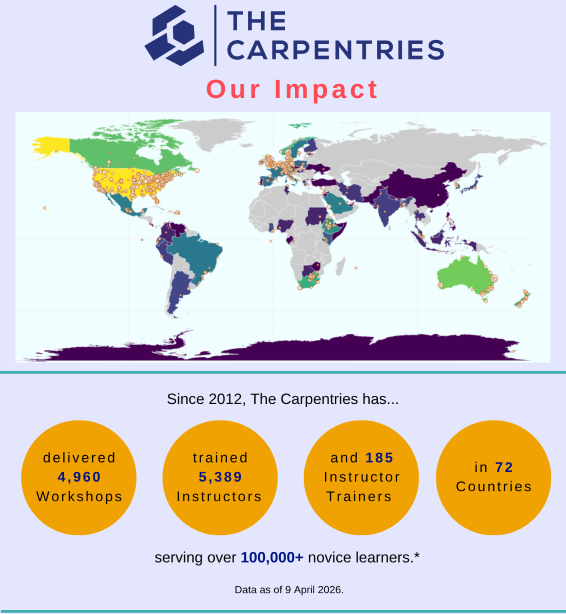
These numbers reflect more than participation. They represent a global network of people working together to support open science, reproducible research, and inclusive training practices.
Building Local Capacity
One of the primary reasons organisations partner with The Carpentries is to build local teaching capacity.
Through Instructor Training, partners can prepare staff, researchers, and educators to become certified Carpentries Instructors. These Instructors then teach workshops within their own organisations and communities.
This approach allows partners to move from occasional training events to a sustainable model where skills development becomes embedded within their institution.
Partnering with The Carpentries has been foundational to our organization’s approach to training. Their instructor training, globally maintained lesson materials, and collaborative community have enabled us to build a robust pedagogical framework and confidently scale the delivery of high-quality technical workshops. We would highly recommend The Carpentries to any organization looking to strengthen and expand their training programs.
Grace Fishbein, Manager, Training and Development, ACENET
In many cases, organisations also collaborate with nearby institutions or regional networks to expand training opportunities and share expertise.
Supporting Researchers and Learners
Carpentries workshops are designed to meet the needs of researchers and professionals who are working with data but may not have formal training in programming or data management.
Workshops focus on practical skills such as:
- working with data in spreadsheets
- programming with Python or R
- version control with Git
- data organisation and reproducible research practices.
Partners frequently report that these workshops help participants become more confident in their work with data while also improving collaboration within research teams.
Partnering with The Carpentries has transformed Virginia Tech’s data education program from a handful of library faculty throwing together workshops as best we can on our own to a campus-wide collaboration that also equips classroom teachers and has a reputation for consistent, timely, high-value instruction. The best testimony I ever received was a graduate student in biosciences who told me the first thing senior students tell new graduate students in their lab is they need to take a Carpentries workshop ASAP.
Dr. Nathaniel D. Porter, Associate Professor and Data Education Coordinator, Virginia Tech University Libraries
Strengthening Collaborative Curriculum
Another important aspect of partnering with The Carpentries is the opportunity to contribute to the development of open lesson materials.
Carpentries lessons are developed collaboratively by Maintainers and contributors across the global community. This open model allows partners to help shape the curriculum while ensuring that lessons remain current and relevant.
Many partners encourage staff to participate in lesson maintenance or join Collaborative Lesson Development Training, where they learn how to design and develop lessons using open-source workflows. This collaboration helps ensure that the curriculum reflects the evolving needs of researchers and educators.
Being part of the Carpentries helps QCIF deliver training that’s not just high‑quality, but genuinely useful for researchers. It gives us access to shared, peer‑reviewed lessons, which means our workshops stay practical, current, and grounded in approaches that actually work for learners.
Rachel McKay, Skills Development Coordinator, QCIF Digital Research
Connecting with a Global Network
Beyond workshops and Instructor Training, Partnerships connect organisations to a global network of practitioners who share a commitment to effective teaching and open collaboration.
Partners participate in community discussions, contribute to lesson development, and share experiences with peers around the world.
For many organisations, this connection to a broader community becomes one of the most valuable aspects of the partnership.
Learn More About the Carpentries Partnership program
The Carpentries Partnership program offers flexible options that allow organisations to tailor their engagement based on their goals.
Partnerships can include combinations of:
- access to workshops covering a wide range of curricula ranging from introductory programming skills to working with specialised data types
- Instructor Training seats
- Collaborative Lesson Development training seats
- professional development courses aimed, for example, at developing practical digital skills
- consultation and support for building local communities of practice.
Whether your organisation is just beginning to explore data and computational skills training or is ready to expand an existing program, partnering with The Carpentries provides a pathway to sustainable capacity building.
If you are interested in learning more about becoming a Partner, visit our Partnership page or contact our team to start the conversation.